- Mar 6
Co-Regulating with Horses: Overcoming Common Struggles and Finding Connection
- Melissa Jean, PT
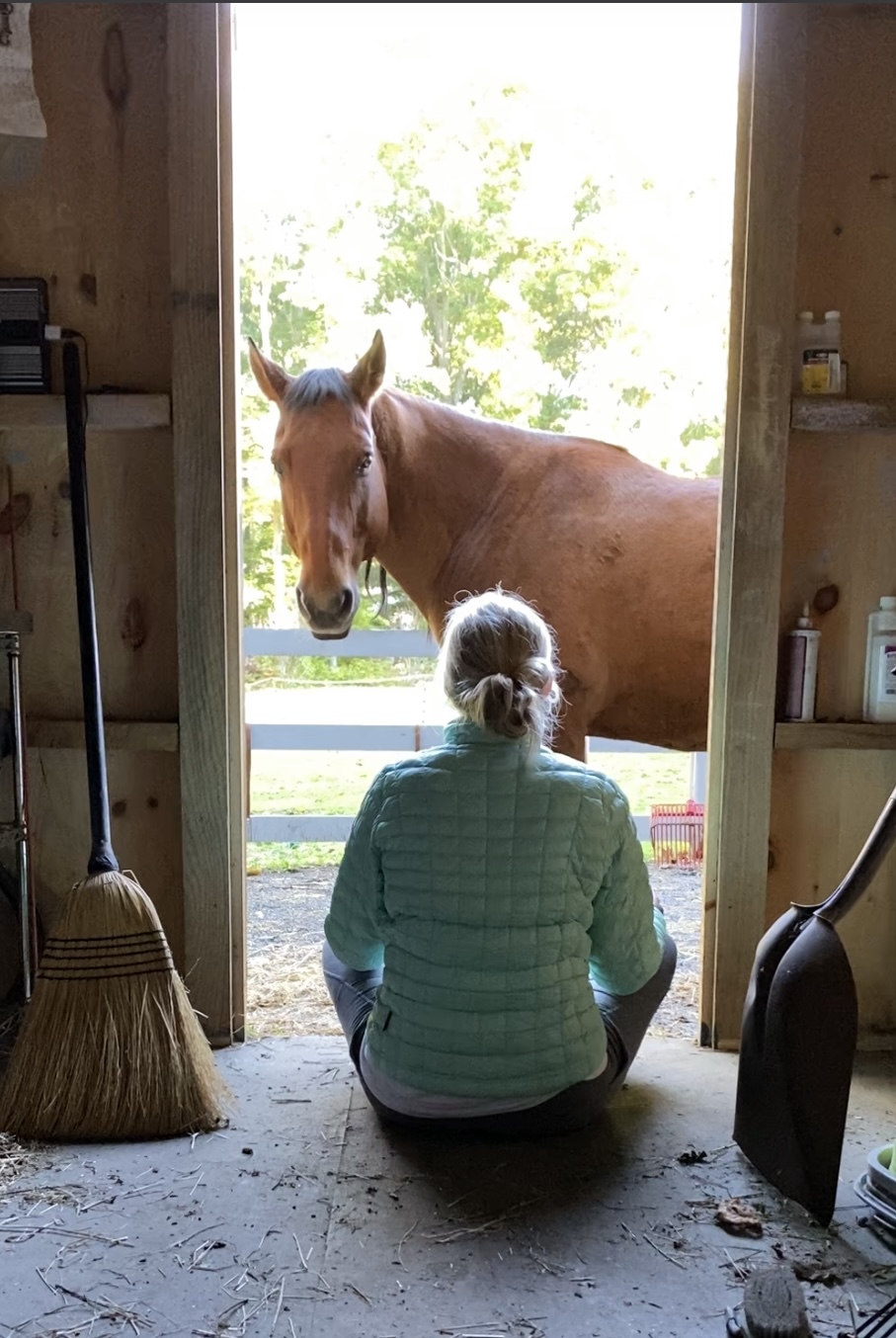
Co-regulation is how one nervous system influences another. Learn how horses — with their naturally lower nervous system baseline — can help humans reset, repair, and heal.
Today I want to talk about the common struggles that come up when you're first beginning to co-regulate with your horse. Please know: the struggle is real, and it shows up even for the calmest among us.
When those moments arise, I want you to come back to the intention of your practice:
1.To improve the resting baseline of your nervous system.
2.To deepen the connection with your horse.
Notice that neither of those intentions involves judging your progress. This is a journey you've chosen to begin, and it deserves to be met with the curiosity of a child — not the pressure of a performance. It's meant to bring you peace, not add to your stress.
With that in mind, here are the questions I'm asked most often.
1. When is the best time to try co-regulating with my horse?
This is the question I hear more than any other, and the honest answer is: it depends. It depends on you, and it depends on your horse.
When you're just starting out, look for a time when you're both fed, neither of you is in a reactive state, and you're not watching the clock. A fed horse is already a calmer horse — you're not competing with the anticipation that builds around grain time. And choosing a moment when neither of you is at a high level of arousal gives the practice the best possible conditions to take hold. We're trying to enhance the peace, not add to the stress.
2. Can I do this while they graze?
Absolutely. Since horses spend much of their day grazing, it's a natural and low-pressure way to begin. Simply being present near them while they eat is a gentle introduction to shared space. I'd just stay away from grain times, when the energy tends to run higher.
3. Is it better to have them on a lead rope or in cross-ties?
As tempting as it is to keep your horse in one place, I don't recommend it. The research on heart rate coupling between horses and humans found that the greatest physiological connection occurred when both the horse and the human were given a choice — the freedom to engage or step away. When we put a horse in cross-ties, we remove that choice, and with it, something important about the quality of the interaction.
4. What if my horse keeps walking away?
This one takes some honest reflection. If you felt an energy shift — a sense of disconnection — just before they moved away, I'd take that as a signal. Thank them for their time and end the session there. If you didn't feel that shift, wait until they settle nearby and try approaching again. What I would not recommend is following your horse around trying to re-establish contact. That tends to have the opposite effect of what you're hoping for.
5. How will I know it's working?
You'll know. Slowly, over time, you'll notice moments of calm where there used to be reaction. Small moments at first — a pause before responding, a breath that comes more easily, a situation that would have rattled you that simply doesn't. Those are the moments you'll smile to yourself and recognize that the practice is doing its work.
I hope this helps as you continue on your journey — reconnecting with yourself while also deepening the relationship with your horse.
If you'd like to read the peer-reviewed research behind co-regulation with horses — including the 2024 HRV synchronization study and the neurobiological basis of Polyvagal Theory in equine-assisted therapy — it's all in one place: Co-Regulation With Horses: The Neuroscience.
Wishing you so much Peace in the Paddock.
Melissa Jean