- Sep 11
What the body knows before the mind catches up
- Melissa Jean, PT
- Horse & Human Nervous System Science
Once, I put two students on horses for the first time. No saddle, no reins, no stirrups, only bareback pads to hold onto and whatever nerve they'd brought with them that morning.
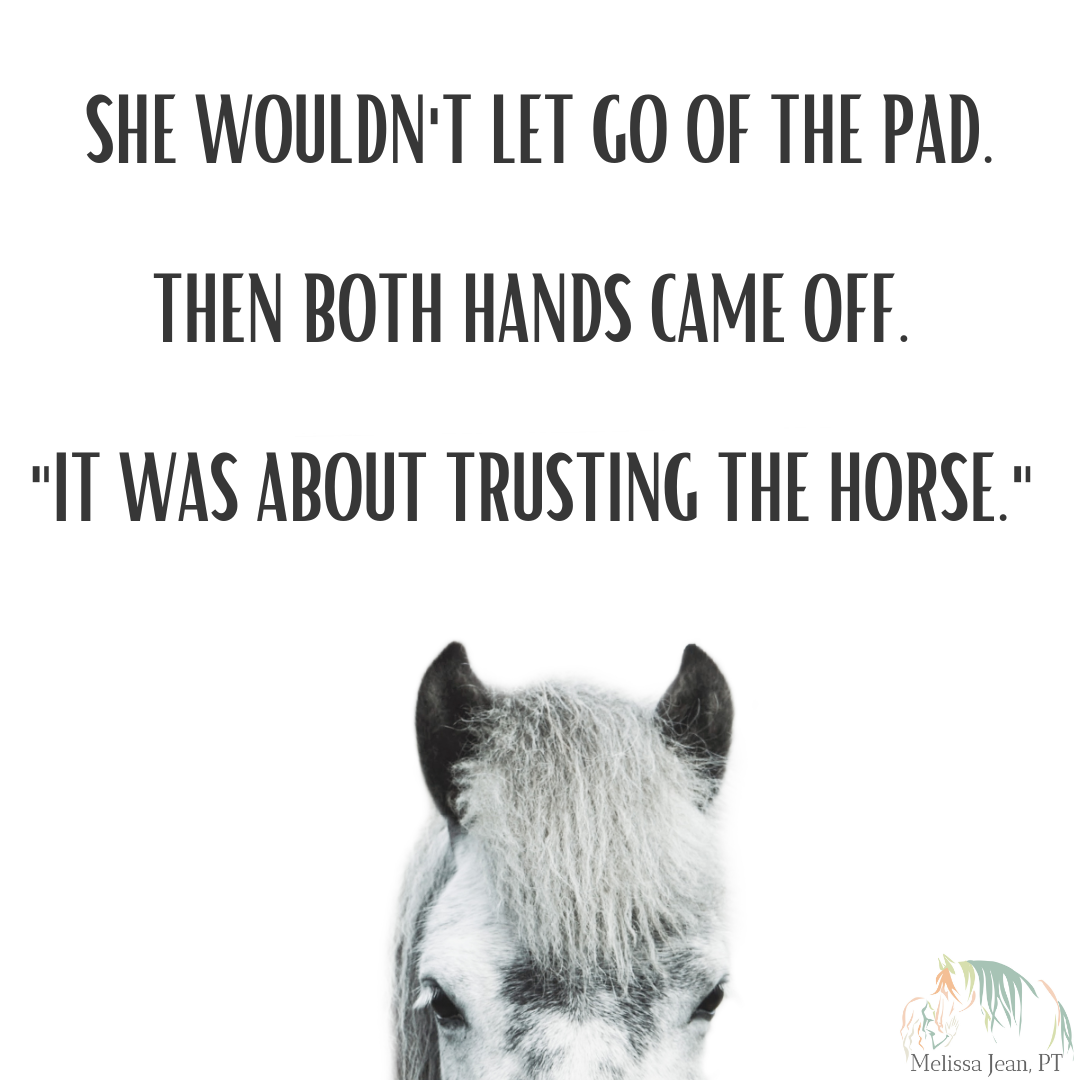
I asked the first one to unclench her jaw and drop her shoulders. She laughed and told me she hadn't noticed her jaw at all, she was too busy trying to stop her legs from gripping. Her hands stayed on the pad the entire ride. She never let go.
The second one got both hands off the pad. Once she did, she said she could feel far more motion moving through her seat, the horse's back doing more work now that she'd stopped fighting it. Then she said something I haven't stopped turning over since. Letting go wasn't about me trusting myself, she said. It was me trusting the horse.
I've built a career on that same sentence, spoken back to me by someone who'd been on a horse for twenty minutes.
Here's what I think was actually happening, underneath both of those rides.
The first student's jaw and legs were held by her somatic nervous system, the part of the nervous system that carries sensation and controls voluntary muscle. Her body was bracing against something new and slightly uncertain before she had any conscious opinion about it. That bracing wasn't a choice. Researchers publishing in the Journal of Neuroscience in 2023 recorded the human amygdala responding to a fear signal in as little as 88 milliseconds, faster than the visual cortex finishes processing what was even seen. The decision that something might be worth guarding against gets made in the limbic system before the thinking brain is caught up. Her held jaw was that decision showing up in muscle.
The second student's release told the other half of the story. Once her hands came off the pad, the sensory information from the horse's movement had a clear path to reach her instead of getting blocked by her own tension. A 2024 review in the journal Behavioral Sciences found that this kind of bottom-up channel, information moving from body to brain through movement, is still under examined compared to top-down approaches like mindfulness, but the authors argue it's just as central to how people actually regulate. Her body let go first. The sentence about trust came after. That order, body then meaning, is usually how it goes.
None of this happens by accident on a horse. The American Hippotherapy Association describes equine movement as multidimensional, rhythmic, and repetitive, delivering well-modulated input to the vestibular, proprioceptive, tactile, and visual systems at once, in a pattern that closely mirrors normal human gait. It's the actual mechanical reason a horse's walk can reach a nervous system that talk cannot.
And the horse isn't a passive partner in any of this. Its nervous system was collecting its own evidence the whole time. One study measured that directly: researchers tracked heart rate, stress hormone levels, and cortisol in eight horses across two very different kinds of rides, one carrying riders who needed full physical guidance through every stride, one carrying total beginners sitting a horse for the first time. Heart rate and stress hormone showed no difference between the two. Cortisol was actually lower during the harder, more demanding ride. That matters to me as much as anything else in this piece. I don't ask a client to trust an animal I haven't first confirmed is regulated enough to be trusted.
We don't do talk therapy at the paddock. We don't go looking for the story underneath what someone's carrying. But the armor still comes down sometimes, usually without warning. A woman crying with no memory surfacing and nothing said out loud. I've come to believe that's the same mechanism from a different angle. Nothing needed to be spoken because nothing about it was ever a story. It was a body finally getting enough signal, from me, from the horse, from the paddock itself, to stop bracing for something that wasn't coming anymore.
If you've ever felt your body do something before your mind caught up to why, on a horse or off one, that's worth paying attention to. It's usually the truest thing happening.
Peace & Love,
Melissa Jean Jarzynski, MSPT, HPCS
Sources