- Mar 6
Co-Regulation with Horses: How Nervous Systems Heal Together
- Melissa Jean, PT
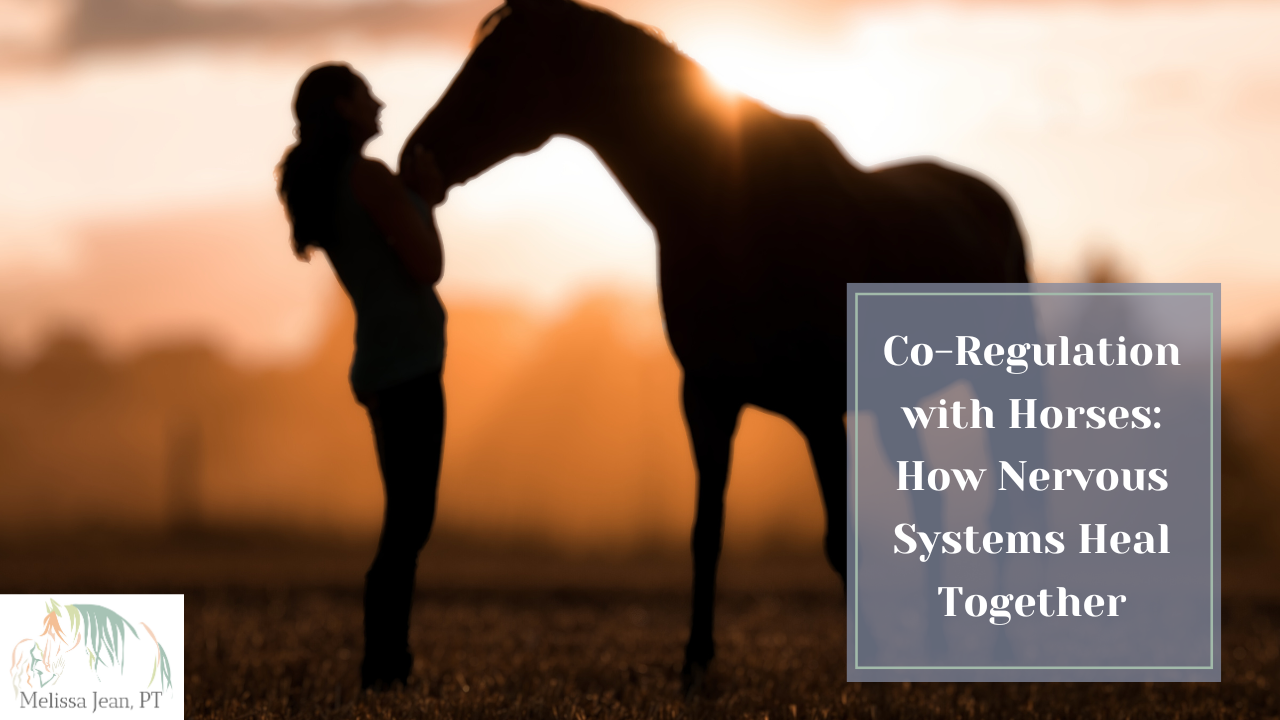
Co-regulation is the way one nervous system influences another. Learn how horses — with their naturally calmer nervous system baseline — can help humans reset, repair, and heal. Discover how partnering with horses restores balance and supports emotional wellbeing.
“People won’t remember what you said, they won’t remember what you did, but they will remember how you made them feel”.
~ Maya Angelou
Because I've heard co-regulation defined in so many different ways, I want to be clear about the definition I'm working from.
Co-regulation is the way one nervous system influences another nervous system.
Your first thought might be: what does that actually mean?
That's a fair question, because co-regulation isn't something you do consciously. It's your body's natural drive toward balance — something to be felt, not thought through.
For those who grew up in less than peaceful environments, or who are navigating chronic stress, addiction recovery, or trauma, balanced co-regulation may have been rare or entirely absent. The nervous system learns from what it's surrounded by.
You may recognize yourself in one of two patterns. You become the chameleon in the room — the one who can read and shift the energy around you, always working to stabilize things. Or you find yourself so saturated by the energy of others that you lose patience at the smallest disturbance.
Both patterns are exhausting. Both leave you depleted.
The good news is that it's never too late to find the internal balance your system has been reaching for. The journey isn't quick, but the changes run deep.
So What About Horses?
This is where science and something that feels like magic meet. Even with my medically trained mind, horses put me in genuine awe.
Horses are prey animals. Their survival has always depended on detecting threat early and conserving energy for when it matters. A healthy, content horse has a resting heart rate of 28 to 40 beats per minute — a nervous system calibrated for vigilance and calm at the same time.
The human nervous system, shaped by very different evolutionary pressures, tends to run at a higher baseline. And when you layer chronic stress or trauma on top of that, the baseline climbs further still. Many of us are running at a level of activation that feels normal simply because we've never known anything else.
This is where the horse becomes something remarkable.
A 2024 study published in iScience used heart rate variability to measure what happens between humans and horses during interaction. The researchers found measurable, two-way physiological coupling — the nervous systems of horse and human influencing each other in real time. The direction of that influence depends on who's leading and how familiar the pair is with one another.
In plain terms: when you stand near a calm horse, your body begins to register that calm. Not because the horse is doing something to you, but because your nervous system is reading the signals it's receiving and slowly adjusting.
By partnering with horses in this way, you can begin to feel what a lower baseline actually feels like. Over time, that becomes a new reference point — a new sense of what it means to be in your own body.
The word partnering here is intentional. Horses are sensitive animals, and they should always have a choice in this work. That principle is at the foundation of my equine wellness program, Finding Peace in the Paddock™.
When we surround a group with calm, content horses and follow with specific, intentional activities, something shifts. People rest. They repair. They grow. And it works. If you'd like to see the research behind it, I've compiled the published science in The Paddock as Laboratory — a free neuroscience guide to horse–human connection.
If you'd like to read the peer-reviewed research behind co-regulation with horses — including the 2024 HRV synchronization study and the neurobiological basis of Polyvagal Theory in equine-assisted therapy — it's all in one place: Co-Regulation With Horses: The Neuroscience.
Peace & Love
Melissa